
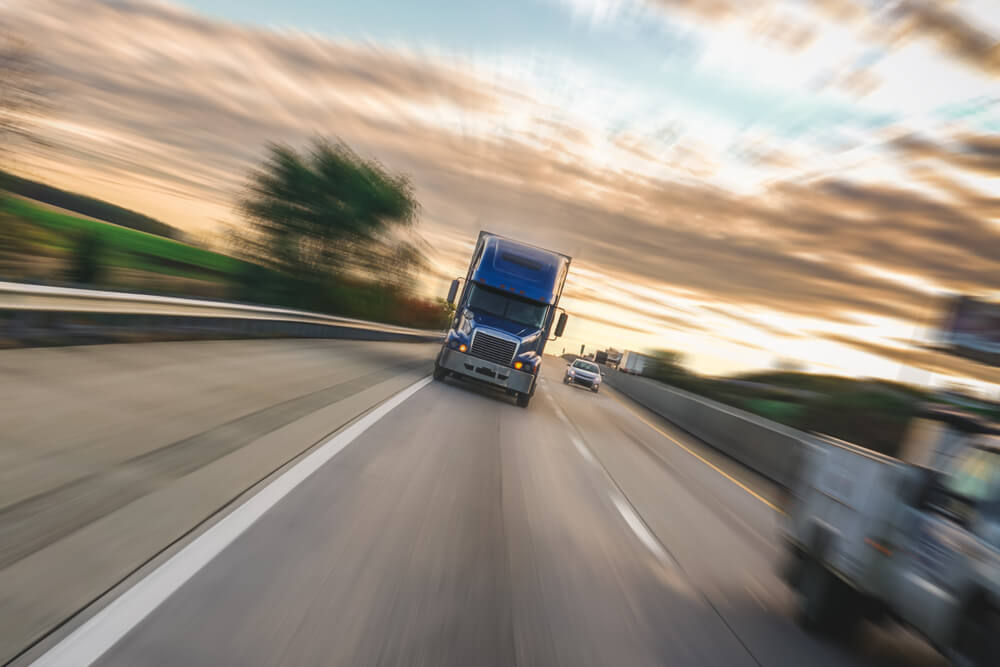
Large commercial trucks, also known as semi-trucks, tractor-trailers, or 18-wheelers, pose a significant risk to other drivers due to their immense size and weight. When an 18-wheeler speeds up, that risk elevates dramatically. Not only do higher speeds create harder impacts, but fast-moving trucks also need significantly more stopping distance than many drivers realize.
At The Thibeaux Firm, we’ve seen the devastation that a speeding 18-wheeler can cause. We help victims of these crashes seek justice and financial stability so they can begin rebuilding their lives. That process starts by understanding the dangers of driving an 18-wheeler too fast and what you can do when those dangers cause you serious harm.
How Speed Affects the Stopping Distance of 18-Wheelers
To understand the impact of speed on stopping distance, you first need to understand the three components of stopping distance:
- Perception Distance: The distance the vehicle travels from the time the driver spots a hazard until the brain recognizes they need to brake
- Reaction Distance: The distance traveled from the time the driver decides to brake until the foot ultimately hits the brake pedal
- Braking Distance: The distance the vehicle travels after the driver steps on the brakes before it comes to a complete stop
The total stopping distance is the sum of perception distance, reaction distance, and braking distance.
The faster a vehicle moves, the longer each of these components becomes. It’s not just that the brakes take a longer time to slow a fast-moving vehicle down; the car also moves a substantial distance before the truck driver can even step on the brakes.
Time is a critical factor and can add hundreds of feet to the total stopping distance at highway speeds. Air brake systems used in large trucks introduce a slight delay known as brake lag, which adds extra distance before braking fully begins. Braking power is affected by road conditions and mechanical factors, which can further impact a truck’s ability to stop safely.
Keep in mind that a fully loaded tractor-trailer traveling at highway speeds can require the length of two football fields or more to come to a complete stop. Adding just five or ten miles per hour to the vehicle’s speed can significantly extend that distance.
Comparison of Vehicle Stopping Distances
The stopping distance of a vehicle is the total distance it travels from the moment the driver decides to stop until the vehicle comes to a complete stop. This distance is influenced by several factors, including the vehicle’s weight and size, road conditions, weather, and braking systems.
When comparing the stopping distances of different vehicles, it becomes clear that semi-trucks have significantly longer stopping distances than typical passenger vehicles. A fully loaded semi- truck can weigh up to 80,000 pounds, which is substantially more than a regular car. This increased weight results in more momentum, requiring more force and distance to stop the vehicle. As a result, semi-trucks have longer braking distances and require more time to come to a complete stop.
In ideal conditions, a fully loaded tractor trailer traveling at 65 miles per hour can take over 600 feet to stop, which is roughly the length of two football fields. In contrast, a typical passenger vehicle traveling at the same speed can stop in about 300 feet. This significant difference in stopping distance highlights the importance of truck drivers maintaining a safe following distance and being aware of potential hazards on the road.
The comparison of vehicle stopping distances also reveals that speed plays a critical role in determining the stopping distance. As speed increases, a vehicle’s stopping distance also increases. For example, a semi-truck traveling at 70 miles per hour will require a longer stopping distance than one traveling at 55 miles per hour. This is because higher speeds result in more kinetic energy, which takes longer to dissipate.
Furthermore, the type of brake system used in a vehicle can also impact its stopping distance. Semi-trucks are equipped with air brakes, which can introduce a slight delay before braking begins. Regular inspections and maintenance of brake systems are essential to ensure optimal braking performance and reduce the risk of truck accidents.
In addition to the vehicle’s characteristics, road conditions and weather also significantly impact stopping distances. Wet, icy, or slippery roads can reduce the traction between the vehicle’s tires and the road, leading to longer stopping distances. Similarly, heavy loads and uneven weight distribution can also affect a vehicle’s stopping distance.
The comparison of vehicle stopping distances emphasizes the importance of safety awareness and responsible driving practices. Truck drivers, in particular, must be aware of their vehicles’ longer stopping distances and take necessary precautions to avoid accidents. This includes maintaining a safe following distance, anticipating potential hazards, following speed limits, and being mindful of road conditions and weather.
Why Increased Stopping Distance Makes Speeding Trucks So Dangerous
Speeding trucks put everyone in the area at risk. If traffic slows suddenly or another hazard arises, the increased stopping distance required can result in a serious collision. Common accidents involving large trucks include:
- Rear-end collisions with smaller vehicles
- Multi-vehicle pileups
- Jackknife accidents
- Underride crashes
Accidents involving semi-trucks often result in severe injuries and fatalities due to the significant weight difference between trucks and passenger vehicles. The size, weight, and velocity of a speeding semi-truck can cause catastrophic injuries in the blink of an eye. Victims of these accidents often suffer permanent disfigurement, amputations, paralysis, and traumatic brain injuries.
How Speed and Weight Increase a Truck’s Stopping Distance
Eighteen-wheelers can weigh up to 80,000 pounds fully loaded. That weight dramatically increases the vehicle’s momentum when it is in motion. The faster the vehicle goes, the greater its momentum, and the harder the brakes must work to overcome that immense force.
Increased stopping distance becomes far more dangerous when a vehicle has poorly maintained brakes, worn tires, or an imbalanced cargo load. Wet road conditions can further increase stopping distance and potentially result in jackknife accidents.
How a Lafayette Truck Accident Lawyer Can Help After a Speed-Related Crash
After a crash involving a speeding truck, you need a skilled attorney to protect your rights. The team at The Thibeaux Law Firm can help by:
- Reviewing your case for free
- Obtain and analyze black box data to identify speeding
- Work with accident reconstruction experts
- Interview witnesses
- Review maintenance and inspection logs
- Review company safety policies
Our truck accident lawyers in Lafayette can identify speeding, gather evidence showing how it caused or contributed to the accident, and demand full compensation on your behalf. Contact us today for your free consultation.